Runs on web.stm
Strut-and-tie (STM) design
Model complex disturbed stress regions with strut-and-tie — a dedicated STM design tool.
The Automatic Design Software for Strut-Tie Model (Truss, Stress Flow, E.S.O, Nodal Zone Analysis)
Key features
- KDS, ACI, AASHTO and Eurocode code support
- Automatic strut-and-tie modeling
- Runs in the browser (3D)
- Released 2014 · English edition since 2016
Product introduction
Introduction
Overview
The Strut-Tie Model (STM) is a design method for disturbed regions (D-regions) adopted by major design codes worldwide.
AStrutTie supports STM design and calculation reports to KDS (strength design and limit state design), ACI 318, AASHTO LRFD and Eurocode 2, and designs the D-regions of building and civil concrete structures: deep beams, corbels, pile caps, pier copings, frame corners and anchorage zones.
AStrutTie 2.0 (2026) runs in the web browser with no installation, and a Windows desktop app is built from the same code.
Every result is verified by an automated gate suite against published hand calculations, SAP2000 and an independent oracle.
Features
Sixteen D-region templates (spread, pile and abutment footings, 3D pile caps, pier/abutment grids, simple and continuous deep beams, corbels, pier copings, frame corners, anchor plates, PSC anchorage zones, box girders and lattice girders) give you a verified strut-tie model in minutes. Modeling, stress-flow comparison, code checks and the report follow one another in a single workspace.
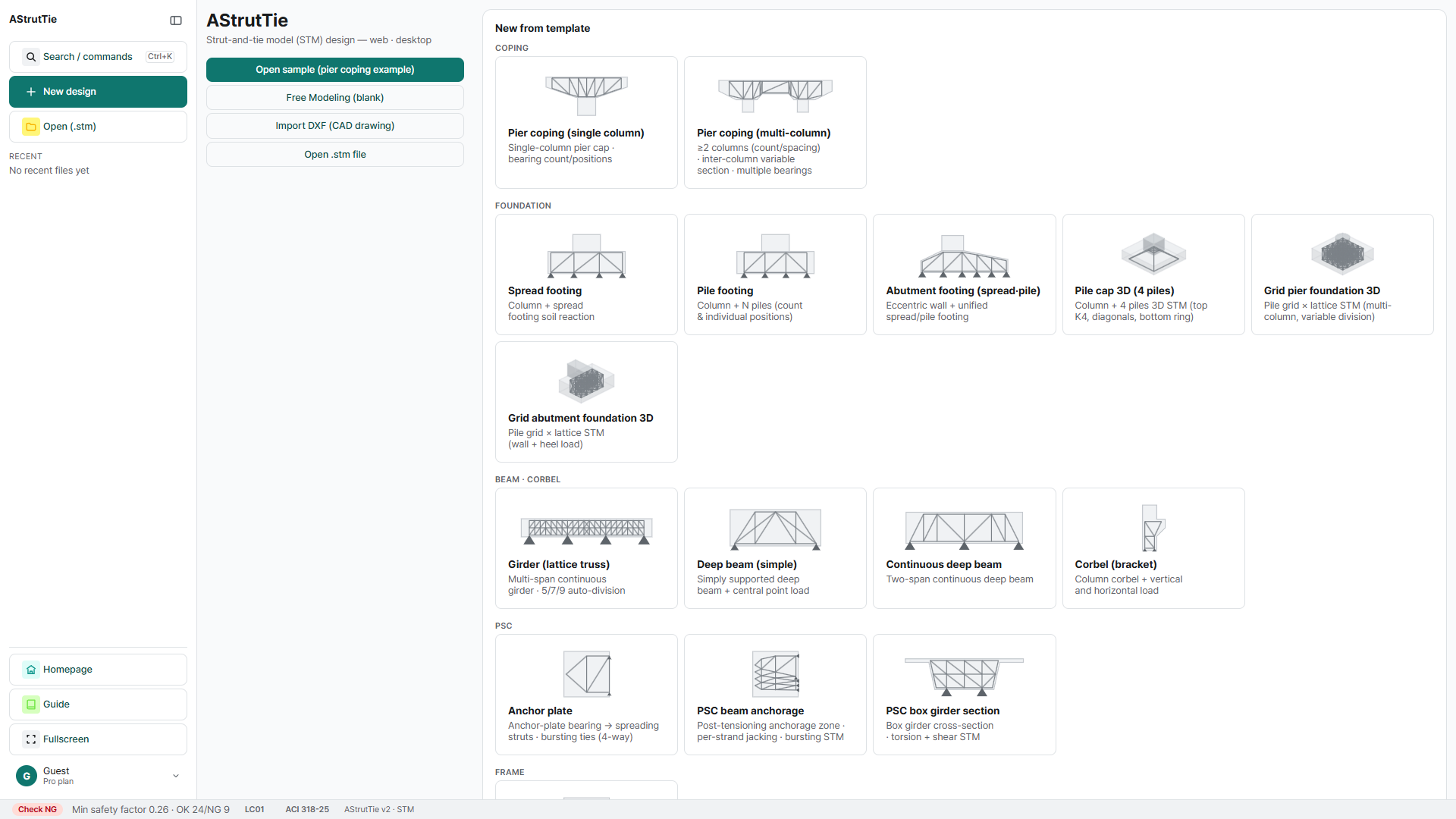
Plans — Free · Standard · Pro
-All plans: browser-based STM design (2D) · five design codes (KDS · KDS-LSD · ACI 318 · AASHTO LRFD · Eurocode 2) · free-form modeling and DXF import · standard templates (coping · footings · deep beam · corbel · frame corner) · principal stress flow analysis · determinate and indeterminate truss analysis · ESO topology assistance · strut, tie and nodal-zone checks-Free: a node limit per model · save and print with a watermark-Standard: unlimited nodes · watermark-free export (save · DXF export · print) · Windows desktop app · AI review assistant-Pro: everything in Standard · 3D STM (pile cap · pier/abutment grids) · advanced templates (PSC anchorage · anchor plate · box girder · lattice girder) · a higher AI allowance-Perpetual license and prices: www.astruttie.com/pricing
Design support
Strut-tie model design
-Designs the D-regions of building and civil concrete structures.-Free-form modeling, with DXF import and export for round-tripping with CAD.-Editing commands familiar from CAD (copy, move, mirror, rotate).-Required and maximum section areas are drawn on the model, so the margin of each member is visible at a glance.
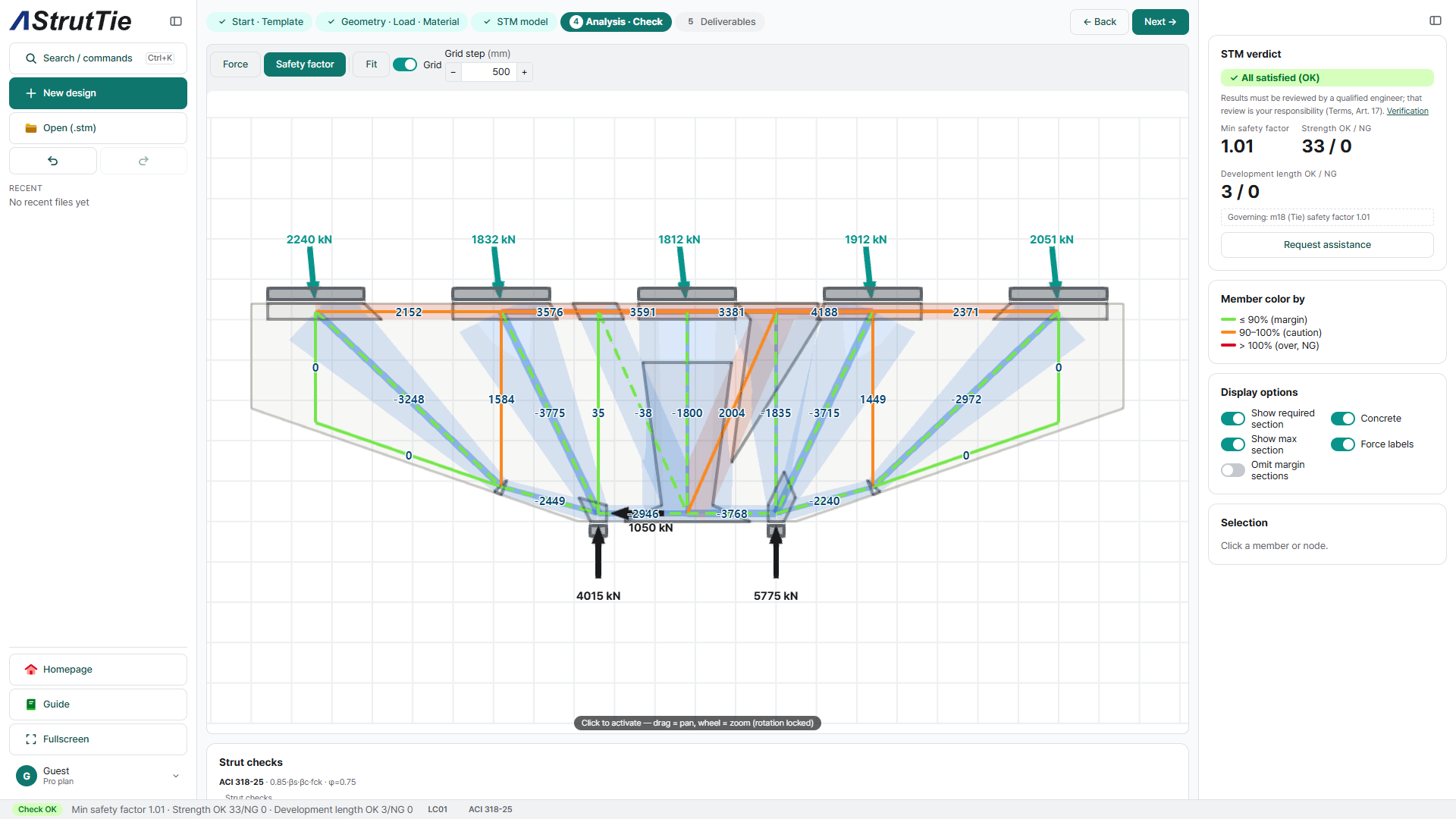
Principal stress flow for truss layout
The principal stress flow from the built-in plane-stress finite-element analysis is overlaid on the strut-tie model. Choosing a truss that follows the load path is the essence of STM; AStrutTie guides that choice from the stress flow and re-runs the strength checks automatically when geometry or loads change.
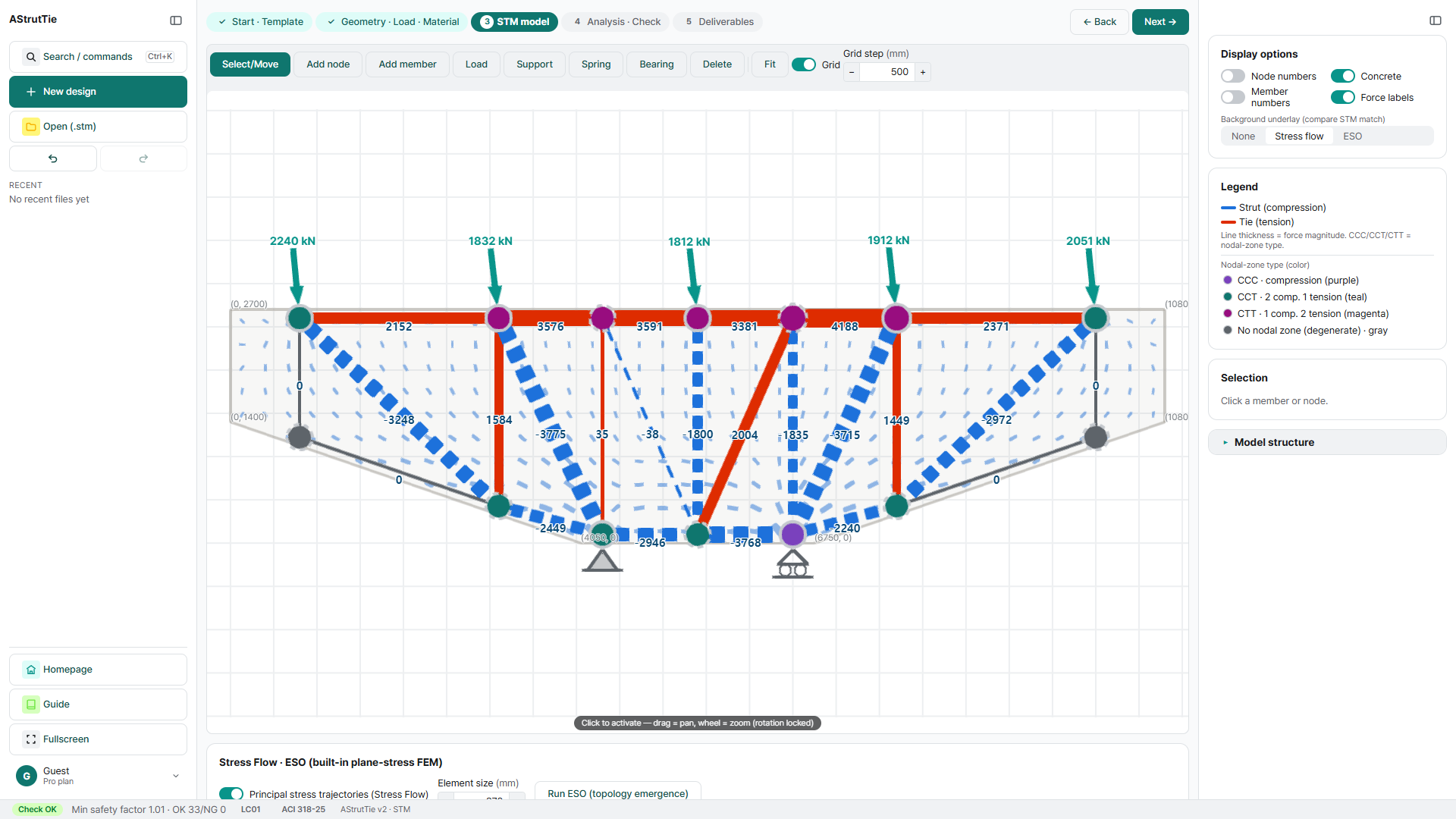
Code checks
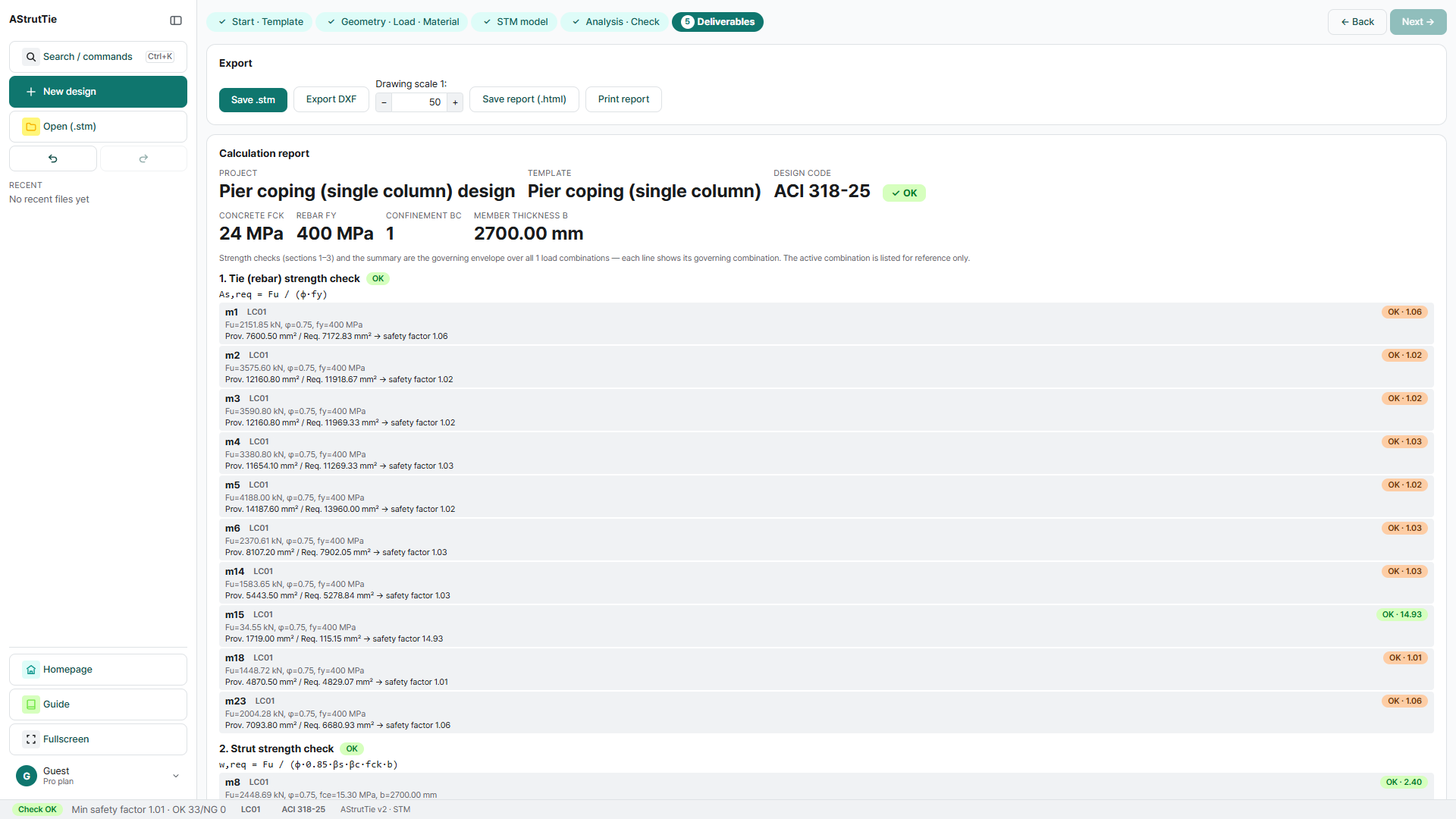
Struts, ties and nodal zones are checked to the selected design code (KDS, KDS-LSD, ACI 318, AASHTO LRFD or Eurocode 2), with pass/fail and the safety factor shown per member. Switch the code on the same model to compare what changes.
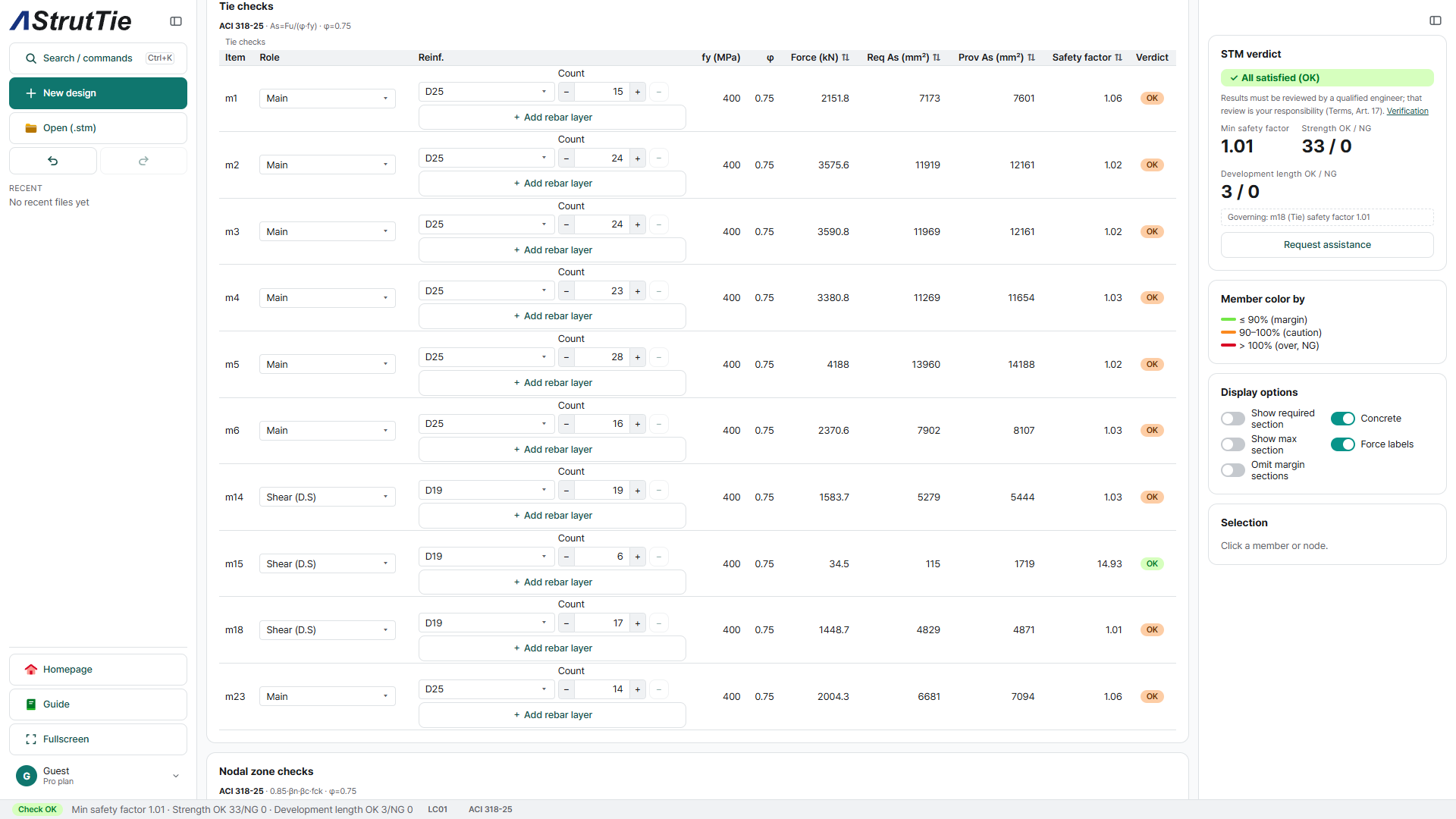
3D strut-and-tie (Pro)
3D pile caps and pier/abutment grid foundations are designed as three-dimensional strut-tie models, with the model, the checks and the report all in 3D (Pro plan).
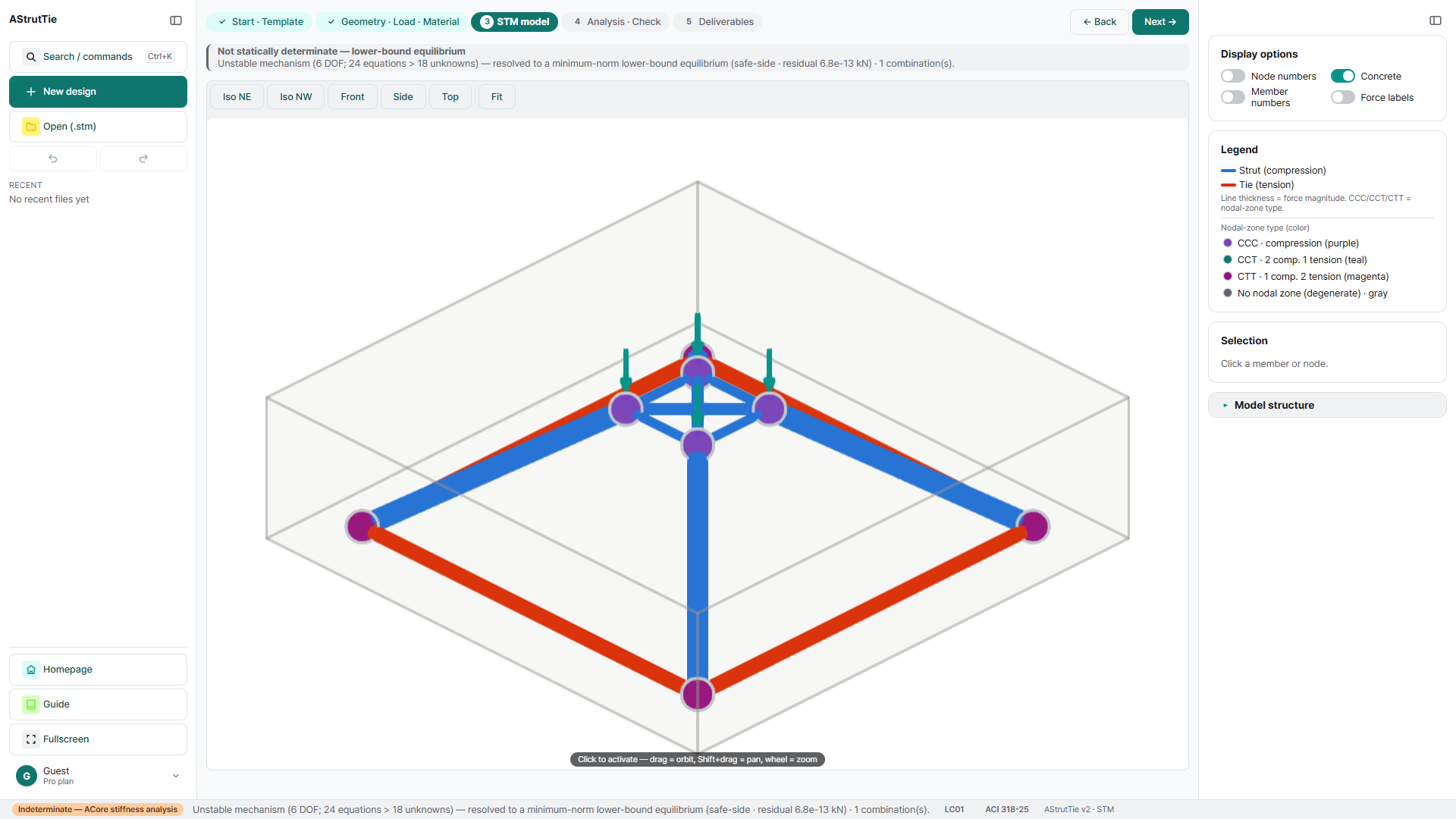
ESO topology assistance
Evolutionary Structural Optimization (ESO) suggests a starting layout for struts and ties. Available on every plan.
Calculation report
A full HTML calculation report, with geometry, member forces and code checks, is generated automatically. Open it in Word or print to PDF; every check is traceable to the code clause. The interface and reports are available in Korean and English.
Dedicated AStrutTie site: www.astruttie.com ↗